
BATON ROUGE, LA — The LSU Museum of Art (LSUMOA) is pleased to announce two major spring exhibitions opening in February 2026: AI: Artistic Interpretations, Studio Art Quilt Associates and Daphnis and Chloe and Other Lovers: Lithographs by Marc Chagall. Together, these exhibitions offer powerful reflections on human creativity—one through the lens of emerging technology and contemporary fiber art, and the other through the timeless, luminous world of Marc Chagall.
AI: Artistic Interpretations, Studio Art Quilt Associates
On view February 5–May 10, 2026
Featuring 35 artists, AI: Artistic Interpretations examines the rapidly evolving relationship between human creativity and artificial intelligence. When asked if it can create art better than a human, ChatGPT responds, “I can produce artworks quickly, combine styles, and iterate without fatigue, but ‘better’ is subjective—humans bring intention, emotion, and lived experience. I excel at tools and variation; humans excel at meaning. The best art often comes from human–AI collaboration.”


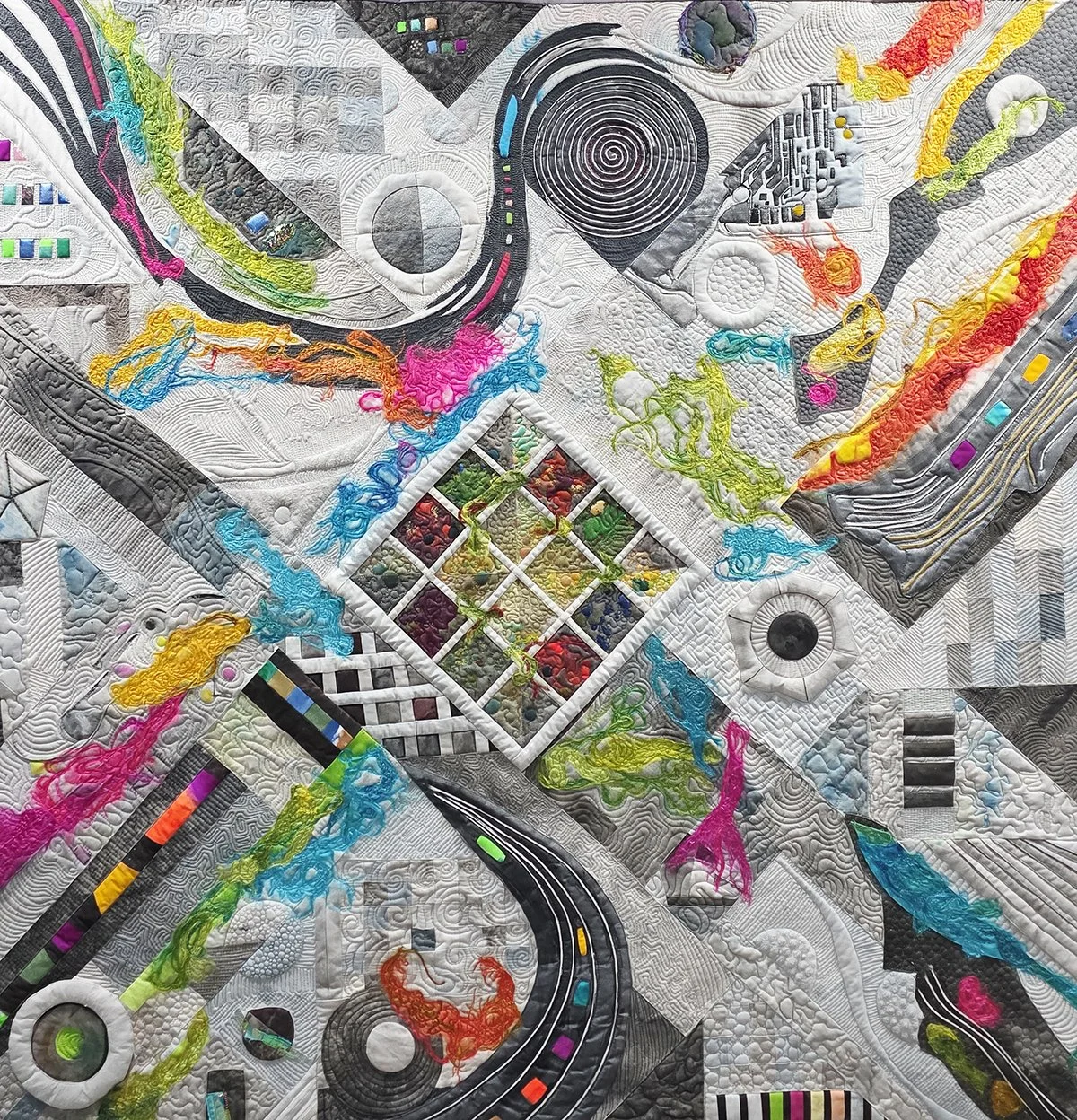

Many artists, creators, and designers worry artificial intelligence will reduce art to mere data or algorithms, replacing their carefully honed skills and creative genius, potentially rendering them obsolete. Others see it as an opportunity to expand imaginative possibilities and explore new forms of expression. To them, AI is a collaborative tool. The fear is real, as is the endless potential, with both sides taking passionate stands. The artists in this exhibition embrace, question, resist, or reinterpret AI’s role in artistic practice:
Susan Polansky exuberantly embraces AI with her Self Portrait, stating, “I am excited to engage with artificial intelligence!! Once limited to science fiction and specialized fields, it is now on my desktop— and I get to be in the first wave of everyday users.” She views the technology as a collaborator, a method for generating novel ideas.
Marisa Marquez views AI as a means to an end, exploring that idea in her work Stitched Syntax. “Just as sewing machines, digital embroidery, and design software expanded our artistic possibilities, AI now emerges as another powerful, yet human-guided tool. This piece celebrates how fiber artists continue to adapt and enrich tradition with technology—not to replace the maker’s hand, but to amplify it.”
Kathy Nida, piece AI is Not My Friend makes her position clear. “Don’t get me wrong, I use AI for work all the time. But I don’t want it to take the place of my creativity. I don’t want it to replace the weird contortions my brain gets into trying to figure out how to make the next piece of art. That’s my joy. That’s what makes life amazing.”
Ultimately, the question isn’t whether AI can make art better than a human—it’s what we want art to be. This exhibition doesn’t offer a definitive answer; instead, it invites viewers to reflect on the evolving relationship between creativity and technology.
Organized by Studio Art Quilt Associates (SAQA), the exhibition was juried by LSU professors Golden Richard III, Ph.D., Brendan Harmon, Ph.D., and LSUMOA Chief Curator Michelle Schulte. AI: Artistic Interpretations will travel nationally following its debut in Baton Rouge.
Exhibition Programs
Daphnis and Chloe and Other Lovers: Lithographs by Marc Chagall
On view February 12–May 24, 2026
This exhibition celebrates Marc Chagall’s mastery of printmaking and color through fifty lyrical lithographs illustrating the ancient Greek romance Daphnis and Chloe, written by Longus in the 2nd century A.D.


Chagall reimagines the pastoral tale of a young goatherd and shepherdess destined for love, infusing the narrative with his characteristic dreamlike imagery and radiant palette. Themes of devotion, longing, and the triumph of love—central to Chagall’s life and artistic practice—emerge vividly throughout the series.
Initially hesitant to accept the 1939 commission from publisher Tériade, Chagall returned to the project after the death of his close friend Pierre Bonnard and during his joyful newlywed years with Valentina Brodsky. Between 1952 and 1954, Chagall traveled through Greece, sketching the landscapes of Lesbos and absorbing its Mediterranean light. Working closely with master printer Charles Sorlier, he developed one of the most celebrated lithographic series of his career, published in 1961 as a limited-edition book.
Chagall’s determination to capture the brilliance and atmosphere of the Mediterranean countryside imbues each print with emotional depth and visual poetry. The exhibition invites visitors to experience the romance, imagination, and color that make Chagall one of the most influential artists of the twentieth century.
This exhibition is organized by Carole Sorell, Inc., curated by David S. Rubin, and presented by the Park West Foundation. It is supported by a grant from the Pennington Family Foundation.
Exhibition Programs
ABOUT LSU MUSEUM OF ART
LSU Museum of Art is supported by a grant from the Arts Council of Greater Baton Rouge, funded by the East Baton Rouge Parish Mayor-President & Metro Council; and in part by a grant from South Arts in partnership with the National Endowment for the Arts. LSUMOA thanks the generous donors to the Annual Fund. Generous support provided by Art Bridges Foundation’s Access for All program. Additional support is provided by generous donors to the LSU Museum of Art Annual Exhibition Fund.
VISITOR INFORMATION
The museum is located in downtown Baton Rouge at 100 Lafayette Street on the Fifth Floor of the Shaw Center for the Arts. General admission is $5 each for adults and children age 13 and over. Admission is free to university faculty and students with ID, children age 12 and under, and museum members. Active-duty military and veterans, first responders, and their families receive free admission with ID as part of the Blue Star Museums program. Show your EBT card and photo ID at the admissions desk and receive free admission for up to 4 individuals as part of the Museums for All initiative. Museum Hours of operation are Tuesday through Saturday, 10 AM–5 PM; Thursday 10 AM–8 PM; Sunday 1–5 PM; and closed on Mondays and major holidays. Free admission occurs on the first Sunday of each month. For more information: visit www.lsumoa.org, call 225-578-3000, and follow the museum on social media @lsumoa for exhibition and program updates.
####